01 / REVIEW
Create child records
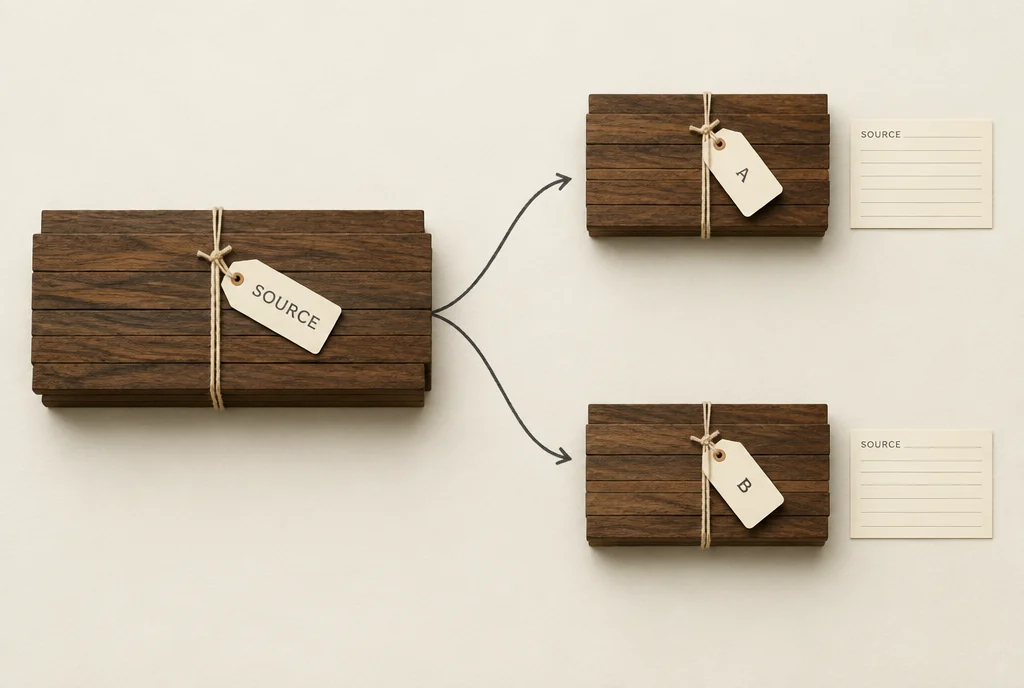
Give each outgoing or retained portion its own identifier and record the parent. Preserve the original parent quantity and unit. Do not replace the parent entry with one child and lose the other branch.
02 / REVIEW
Reconcile the split
Record quantities for all branches and explain any documented adjustment. If quantities are unknown, keep them unknown and mark the reconciliation incomplete.
03 / REVIEW
Carry scoped documents
Link applicable source documents to the child records while retaining their original scope. If a document covers only part of the parent, do not automatically apply it to every child.
Dividing material creates a record event
When part of a lot goes to one project and the rest stays in stock, the original record should remain intact. Create child records for the portions and connect each to the parent. Record the quantity, unit, date and destination of the split. This keeps one source lot from appearing to remain fully available after part of it has left.
A split can happen without a sale: machining, sampling, damage segregation or moving stock into a different production stage may create separately managed portions. The important question is whether someone will need to identify that portion independently later.
Reconcile the quantities at the split
In a fictional example, a parent lot contains 120 pieces of one documented size and length. Seventy pieces move to Project A, 45 remain available and five are set aside for investigation. The record reconciles to 120 pieces. The five set aside should not disappear into a vague adjustment or remain counted as available stock.
| Child record | Quantity | Status |
|---|---|---|
| Parent-A | 70 pieces | Issued to Project A |
| Parent-B | 45 pieces | Available stock |
| Parent-H | 5 pieces | Held pending review |
| Reconciliation | 120 pieces | Matches the parent quantity |
That example works because the units and pieces are comparable. If material is cut into different lengths, piece count alone no longer preserves the quantity relationship. Retain dimensions or another appropriate quantity basis and document the processing event.
Carry evidence forward with its limits
A child lot can point to the parent's documents, but the record must show why those documents apply. If a parent record contains unresolved species or origin information, splitting it does not resolve the uncertainty. Likewise, one document covering only part of a shipment should not be attached indiscriminately to every child lot.
Keep operational traceability separate from certification accounting. A certification scheme may impose its own rules for claims, transfers and inventory controls. An internal parent-child table is not a substitute for those rules and does not authorize use of a certification claim.
If two lots are later combined, record that as a separate merge with both inputs identified. Do not rename the combined material as though it came from a single original lot. The quantity reconciliation guide helps preserve the arithmetic; the evidence record preserves what can legitimately be said about each portion.
A lot-record scenario
Fictional example: 120 pieces split into 70 for project A and 50 for project B. The children retain the parent reference; project names are destinations, not new source evidence.
Use the result
Keep the completed review with the relevant project record. Assign unresolved items before relying on a conclusion. If the material, condition or document changes, revisit the affected questions.
Evidence workspaceTechnical references
General background for the subject. Project worksheets and fictional situations are original review aids, not official agency forms.
APHIS: Lacey declaration guidance